
When Clutter Becomes an Estate Planning Problem
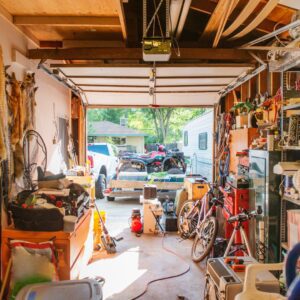
Comedian George Carlin once joked that a house is just a place to keep your stuff while you go out and get more. “Sometimes you gotta move, gotta get a bigger house,” he said. “Why? No room for your stuff anymore.”[1]
For many Americans, that joke hits close to home. We have a complicated relationship with our possessions, recognizing on some level that we may own too much even as we continue to accumulate more. The United States is one of the world’s leaders in consumer spending,[2] and while trends such as minimalism come and go, our belongings tend to keep piling up.
There is nothing inherently wrong with owning things. We work hard, and buying something new can feel like a reward. But over time, those rewards can start to weigh on us, creating stress, taking up space, and even leaving behind a burden for the people we care about.
The question is not just what we own. It is what happens to it later—who is left to sort through it, manage it, and ultimately decide what comes next.
America Has a Clutter Problem
An oft-cited statistic claims the average American home has 300,000 items in it.[3] While that number has been disputed, there is no debate that Americans own a great deal of stuff. And it is stressing us out.
- 25 percent of Americans admit to having a “clutter problem”[4]
- 84 percent worry that their homes are not organized enough[5]
- 55 percent say clutter is a major cause of stress[6]
Why do we accumulate so much?
Part of the answer has nothing to do with being American and everything to do with being human. We are predisposed to accumulate, in part because we evolved under conditions of scarcity.[7] It is the same reason we have trouble denying ourselves fats and sweets; our brains crave unnecessary items the way they crave unhealthy foods. Research also suggests that objects appeal to us on an emotional level, giving us a sense of security and connection to the past and to the people we love.[8]
Meaning, however, is subjective. Physical items may be tied to memory and identity in ways that are not easily unpacked.[9] What feels indispensable to one person may be meaningless to someone else. And when the time comes to administer an estate—to go over everything and decide what to do with it—those differences can trigger issues that far exceed any given item’s size, weight, or monetary value.
Why Being “Stuff-Blind” Can Complicate Estate Administration
There is a concept known as “nose blindness”—when your brain becomes so accustomed to a constant scent that it stops noticing it.[10] A similar phenomenon can happen with possessions. Over time, people can develop “clutter blindness,”[11] gradually losing awareness of how much they have accumulated.
Accumulating items and struggling to let go of them is normal. One person’s collection may be another’s clutter. But when belongings build up over a lifetime, the result can complicate estate administration far more than many people expect.
One way to assess the situation is to ask a few simple questions:
- Can you comfortably and safely move through every room in your home?
- Are important documents organized and easy for someone else to locate?
- If your home needed to be cleared out for sale, would it take days, weeks, or months?
Your answers will signal whether the amount of stuff you own—or the way it is organized—might causeproblems down the line. If those issues are not addressed now, they will almost certainly fall to someone else later.
Potential complications that may arise during estate administration include the following:
- Missed or undiscovered assets. When family members or executors are organizing and inventorying a home under time pressure, something important may be overlooked or mistaken for junk.
- Delays in the probate process. Estate administration typically takes six to 12 months or longer. If a home contains decades of accumulated belongings, sorting, cataloging, and distributing personal property can add weeks or months to the process.
- Difficulty determining the value of property. After someone dies, their personal property often needs to be appraised. If belongings are disorganized, it can be harder to figure out what is there, which may lead to overlooking valuable items or incorrect valuations.
- Higher administrative costs. In a heavily cluttered home, professional estate cleanout services and the work of identifying and cataloging personal property can cost thousands of dollars,[12] and that is before expenses such as junk removal, estate sale commissions, or auctioneer fees.
- Delays in preparing or selling real estate. Sometimes, homes cannot be listed for sale until the contents have been removed. Excess clutter can push back the typical estate sale timeline and increase costs for utilities, insurance, and property taxes.
- Safety concerns that may limit the ability to age in place. Most older adults want to age at home,[13] buttheir house must be able to accommodate them as they grow older. Severe clutter can create fall hazards, block exits, and interfere with routine home maintenance.
- Trouble locating essential documents. Important records such as wills, trusts, insurance policies, account statements, passwords, and other key documents may be misplaced or buried among household belongings, complicating estate administration and financial decisions after death.
You cannot take it with you—but what you leave behind does not simply disappear. It becomes someone else’s responsibility to sort through, manage, and resolve, and it can turn into a complex, time-consuming problem for the people you care about most.
[1] George Carlin – Stuff, The Frug (July 13), https://thefrug.com/george-carlin-stuff.
[2] Understanding the US Consumer Market: Key Trends and Insights, Rsch. FDI (Mar. 15, 2023), https://researchfdi.com/understanding-the-us-consumer-market.
[3] Jean Chatzky, One in Four Americans Has a Clutter Problem — And Could Be Sitting on Some Serious Cash, NBC News (May 31, 2017), https://www.nbcnews.com/business/personal-finance/one-four-americans-has-clutter-problem-could-be-sitting-some-n766681.
[4] Id.
[5] Id.
[6] Id.
[7] Archana Ram, Why Do We Keep Buying New Stuff?, Patagonia (Nov. 15, 2023), https://www.patagonia.com/stories/culture/design/feeling-like-new/story-144207.html.
[8] Christian Jarrett, The psychology of stuff and things, The British Psych. Soc’y (Aug. 13, 2013), https://www.bps.org.uk/psychologist/psychology-stuff-and-things.
[9] Christopher R. Madan, Memory Can Define Individual Beliefs and Identity—and Shape Society, Sage J. (Dec. 13, 2023), https://journals.sagepub.com/doi/10.1177/23727322231220258.
[10] The Science Behind Olfactory Fatigue, Malibu Apothecary (Sept. 17, 2025), https://malibuapothecary.com/blogs/clean-candles/the-science-behind-olfactory-fatigue-why-you-stop-smelling-a-scent.
[11] Gretchen Rubin, Are You Clutter-Blind? Or Do You Know Someone Who Is?, Psych. Today (May 16, 2016), https://www.psychologytoday.com/us/blog/the-happiness-project/201605/are-you-clutter-blind-or-do-you-know-someone-who-is.
[12] Deirdre Sullivan, How Much Do Estate Cleanout Services Cost? [2026 Data], Angi (Apr. 4, 2026), https://www.angi.com/articles/estate-cleanout-services-cost.htm.
[13] Kim Parker and Luona Lin, Most older adults who live at home want to age in place, but they aren’t entirely confident they’ll get to, Pew Rsch. (Feb. 26, 2026), https://www.pewresearch.org/short-reads/2026/02/26/most-older-adults-who-live-at-home-want-to-age-in-place-but-they-arent-entirely-confident-theyll-get-to.